It's all about ...
plants


Wintry Winehouse Chinese Evergreen
Aglaonema 'Wintry Winehouse'

Height: 3 feet
Spread: 3 feet
Sunlight:


Hardiness Zone: 10b
Description:
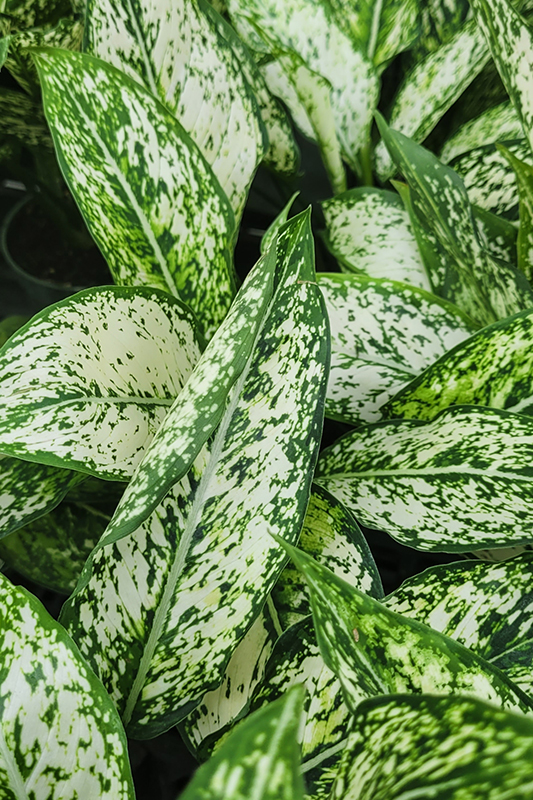
A very popular houseplant that is very easy to grow; survives poor lighting and low ventilation; dark green leaves display creamy-white variegation; can be planted outdoors in warm climates, or in containers, brought in during cold weather
Ornamental Features
Wintry Winehouse Chinese Evergreen's attractive pointy leaves remain green in colour with showy creamy white variegation throughout the season on a plant with an upright spreading habit of growth.
Landscape Attributes
Wintry Winehouse Chinese Evergreen is an herbaceous perennial with an upright spreading habit of growth. Its medium texture blends into the garden, but can always be balanced by a couple of finer or coarser plants for an effective composition.
This is a relatively low maintenance plant, and may require the occasional pruning to look its best. It has no significant negative characteristics.
Wintry Winehouse Chinese Evergreen is recommended for the following landscape applications;
- Accent
Planting & Growing
Wintry Winehouse Chinese Evergreen will grow to be about 3 feet tall at maturity, with a spread of 3 feet. Its foliage tends to remain dense right to the ground, not requiring facer plants in front. It grows at a slow rate, and under ideal conditions can be expected to live for approximately 10 years. As an herbaceous perennial, this plant will usually die back to the crown each winter, and will regrow from the base each spring. Be careful not to disturb the crown in late winter when it may not be readily seen!
This plant does best in partial shade to shade. It prefers to grow in average to moist conditions, and shouldn't be allowed to dry out. This plant should not require much in the way of fertilizing once established, although it may appreciate a shot of general-purpose fertilizer from time to time early in the growing season. It is not particular as to soil type or pH. It is quite intolerant of urban pollution, therefore inner city or urban streetside plantings are best avoided. This particular variety is an interspecific hybrid, and parts of it are known to be toxic to humans and animals, so care should be exercised in planting it around children and pets. It can be propagated by division; however, as a cultivated variety, be aware that it may be subject to certain restrictions or prohibitions on propagation.
This plant is not reliably hardy in our region, and certain restrictions may apply; contact the store for more information.


