It's all about ...
plants


Height: 3 feet
Spacing: 3 feet
Sunlight:

Hardiness Zone: 6a
Other Names: Dorr's Sage, Purple Sage, Gray Ball Sage
Description:
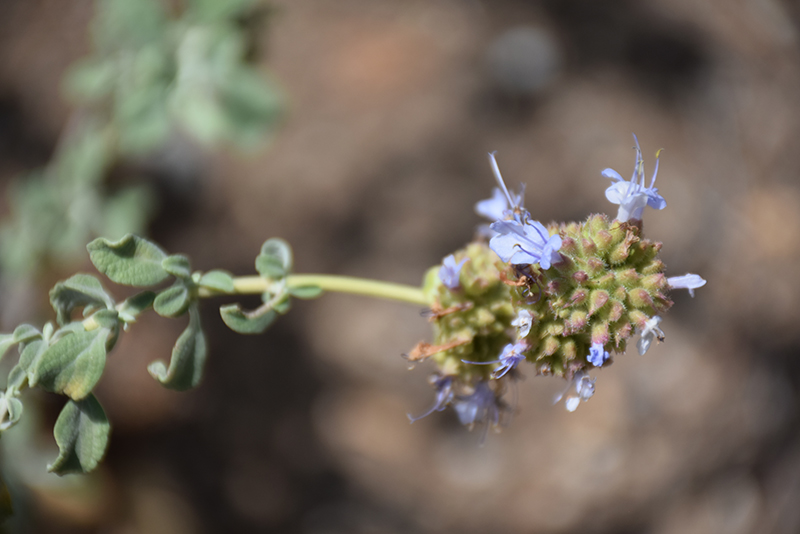
Spectacular deep blue-violet flowers with pinkish-purple bracts are borne in whorls above silvery-gray, aromatic foliage on this woody evergreen sub-shrub; heat and cold hardy, requiring little water; flowers over a long season; great for xeriscaping
Ornamental Features
Desert Sage has masses of beautiful clusters of fragrant violet flowers with blue overtones and rose bracts rising above the foliage from late spring to late summer, which are most effective when planted in groupings. The flowers are excellent for cutting. Its small tomentose oval leaves remain grayish green in colour with hints of silver throughout the year.
Landscape Attributes
Desert Sage is a multi-stemmed evergreen perennial with a mounded form. Its medium texture blends into the garden, but can always be balanced by a couple of finer or coarser plants for an effective composition.
This is a relatively low maintenance plant, and should only be pruned after flowering to avoid removing any of the current season's flowers. It is a good choice for attracting bees, butterflies and hummingbirds to your yard, but is not particularly attractive to deer who tend to leave it alone in favor of tastier treats. It has no significant negative characteristics.
Desert Sage is recommended for the following landscape applications;
- Mass Planting
- Rock/Alpine Gardens
- Border Edging
- Groundcover
- Naturalizing And Woodland Gardens
- Container Planting
Planting & Growing
Desert Sage will grow to be about 30 inches tall at maturity, with a spread of 4 feet. When grown in masses or used as a bedding plant, individual plants should be spaced approximately 3 feet apart. Although it is technically a woody plant, this plant can be expected to behave as a perennial in our climate if planted outdoors over the winter, usually regrowing from its base (crown) the following year. As such, gardeners should take into consideration that it will perform differently than it would in its native habitat.
This plant should only be grown in full sunlight. It is very adaptable to both dry and moist growing conditions, but will not tolerate any standing water. It is considered to be drought-tolerant, and thus makes an ideal choice for a low-water garden or xeriscape application. This plant does not require much in the way of fertilizing once established. It is not particular as to soil pH, but grows best in sandy soils. It is somewhat tolerant of urban pollution. Consider applying a thick mulch around the root zone in winter to protect it in exposed locations or colder microclimates. This species is native to parts of North America. It can be propagated by cuttings.
Desert Sage is a fine choice for the garden, but it is also a good selection for planting in outdoor pots and containers. Because of its height, it is often used as a 'thriller' in the 'spiller-thriller-filler' container combination; plant it near the center of the pot, surrounded by smaller plants and those that spill over the edges. It is even sizeable enough that it can be grown alone in a suitable container. Note that when growing plants in outdoor containers and baskets, they may require more frequent waterings than they would in the yard or garden. Be aware that in our climate, most plants cannot be expected to survive the winter if left in containers outdoors, and this plant is no exception. Contact our experts for more information on how to protect it over the winter months.
This plant is not reliably hardy in our region, and certain restrictions may apply; contact the store for more information.